

The goals of the Air Toxics “Hot Spots” Information and Assessment Act (AB 2588, 1987. Connelly), which was enacted in 1987, are to collect emissions data, identify facilities having localized impacts, ascertain health risks, notify nearby residents of significant risks and reduce significant risks to acceptable levels. The program addresses routine and predictable emissions, but not unforeseen, accidental releases.
The act requires that:
- Toxic air emissions from facilities be quantified and compiled into an inventory according to criteria and guidelines developed by the California Air Resources Board (CARB)
- Each facility be prioritized to determine whether a risk assessment must be conducted
- The risk assessments be conducted according to methods developed by the Office of Environmental Health Hazard Assessment (OEHHA)
- The public be notified of significant risks posed by nearby facilities, and that emissions that result in those risks be reduced
The Toxics “Hot Spots” Act is a public-right-to-know program. The following air toxics information developed under the act is publicly available:
- CARB maintains the toxics emissions data in its Facility Search Tool.
- The district makes health risk assessments available for public review upon request.
- The district publishes annual reports that summarize the results of the health risk assessment program, rank and identify facilities according to the cancer risk and noncancer risks posed, and describe the status of the development of control measures.
The Air Toxics "Hot Spots" Process
The Air Toxics “Hot Spots” Act requires CARB to compile and maintain a list of substances posing cancer or chronic or acute health impacts when present in the air. Over 600 substances have been listed under the act.
Ventura County facilities are subject to the act if they manufacture, formulate, use or release a listed substance and either emit 10 tons or more per year of criteria pollutants (total organic gases, particulate matter, nitrogen oxides or sulfur oxides) or less than 10 tons per year of criteria pollutants.
Facilities submit inventory plan and report
The Air Toxics “Hot Spots” Act requires subject facilities to prepare air toxics emission inventory plans and, subsequently emission inventory reports. The Emission Inventory Criteria and Guidelines Report, which was first approved by CARB in 1989, provides specifications for acceptable emission inventory plans, reports and updates. Portions of the guidelines were amended by CARB several times since then. The current version of the guidelines became effective in 2007.
Facility operators must submit to the district a proposed emission inventory plan indicating how emissions will be measured or calculated. The district must approve, modify or return the inventory plan to the operator for revisions within 120 days. Once the district approves a plan, the facility operator must implement the plan and submit the emission inventory report within 180 days. For certain classes of facilities, the district must prepare industrywide inventories. In this case, individual facility reports are not required. The district determines which facilities will be covered by industrywide inventories based on conditions such as economic hardship and small business status.
Facilities subject to the program must update their emission inventories every four years. The update requirements were streamlined in 1993 and are now based on each facility’s prioritization category. The new update requirements substantially reduce reporting requirements for all but the significant risk facilities.
District sets priority level
After reviewing emission inventory data, the district ranks facilities for purposes of risk assessment into high, intermediate and low priority categories. Facilities are reprioritized if their inventory update shows any significant changes.
In establishing priorities, the district considers the potency, toxicity and quantity of hazardous materials released from the facility, the proximity of the facility to potential receptors and any other factors that the district determines indicate that a facility may pose a significant risk.
The California Air Pollution Control Officers Association (CAPCOA) has developed Air Toxics “Hot Spots” Program Facility Prioritization Guidelines to provide districts with suggested procedures for use in prioritizing facilities. These guidelines were updated in 2016. The Ventura County Air Pollution Control Board adopted Prioritization Procedures based on the CAPCOA guidelines. The Prioritization Procedures were amended to incorporate the updated CAPCOA guidelines in 2023.
High-priority facilities assess health risk
Within 150 days of the designation of priorities, high priority facilities must prepare and submit a health risk assessment to the district. A risk assessment, as defined under the Air Toxics “Hot Spots” Act, includes a comprehensive analysis of the dispersion of hazardous substances into the environment, the potential for human exposure and a quantitative assessment of both individual and population-wide health risk associated with those levels of exposure. The district may grant a 30-day extension for submittal of the risk assessment. The risk assessments are reviewed by the district and OEHHA.
OEHHA has developed the 2015 Air Toxics Hot Spots Program Risk Assessment Guidelines for preparing the health risk assessments required under the Air Toxics “Hot Spots” Act. These guidelines replaced a version released in 2003. The update to the Risk Assessment Guidelines was triggered by SB 25, Children’s Environmental Health Protection, which required that the increased sensitivity of infants and children to toxics be specifically addressed. CAPCOA and CARB adopted the Risk Management Guidance for Stationary Sources of Air Toxics, which should be used to prepare “Hot Spots” risk assessments. Use of the OEHHA guidelines is required by law. CARB has developed the Hotspots Analysis and Reporting Program (HARP) software, which can be used to prepare “Hot Spots” risk assessments. Meteorological data for Point Mugu and Camarillo and Oxnard airports to be used for risk assessment dispersion modeling is available on the CARB website. Additional meteorological data sets also are available from district-operated air monitoring stations in El Rio, Ojai, Piru, Simi Valley and Thousand Oaks.
District notifies public
The CAPCOA Toxics Committee has also developed Public Notification Guidelines to assist districts. The Ventura County Air Pollution Control Board has adopted public notification procedures based on the CAPCOA Guidelines.
Facilities found to have a significant risk must conduct an airborne toxics risk reduction audit and develop a plan to implement reduction measures. The audit and plan must be submitted to the district within six months of the determination. They must describe the methods the facility will use to reduce risk below the level of significance within five years. The district may shorten or lengthen the time period (up to five additional years) under certain conditions.
Fee Schedule
The Air Toxics “Hot Spots” Act requires that CARB develop and adopt a fee regulation that recovers the state’s costs to implement the program. The regulation also requires each district to adopt a fee schedule that recovers the costs to the district or request that CARB adopt a fee schedule for them. The regulation establishes each district’s share of the state’s costs. The fee regulation is reviewed annually and updated to accommodate changes in the facilities subject to the program. In response to this requirement, the Ventura County Air Pollution Control Board adopted Rule 46. Under Rule 46, fees are based on prioritization scores and health risk assessment results.
Generally, fee rates increase with increasing risks. Each district is responsible for billing and collecting fees from all facilities subject to the act and remitting the district’s share of the state costs to CARB.
Conclusion
In summary, the Air Toxics “Hot Spots” Act establishes a formal air toxics emission inventory and risk quantification program. The goal of the “Hot spots” Act is to collect emission data indicative of routine predictable releases of toxic substances to the air; identify facilities having localized impacts; evaluate health risks from exposure to the emissions; notify nearby residents of significant risks; and reduce risks below the level of significance. Information gathered from this program has complemented the state’s existing toxic air contaminant program. Additionally, the program has been a factor motivating facility owners to voluntarily reduce their toxic emissions.
Annual Reports
Download below.
Meteorological Data
The following AERMOD-ready meteorological data sets are available for dispersion modeling in Ventura County. These input files were processed using the AERMET program from Lakes Environmental. They are developed based on the five years of data sets covering Jan. 1, 2015, through Dec. 31, 2019 and are from six air monitoring stations located in Ventura County and operated by the district. The table below lists the names, locations and AERMOD-ready meteorological data sets of those stations. If you have any questions regarding which dataset is best suitable for your project, contact Wunna Aung at 805-303-3659.
Met Data Sets
| El Rio | 34.25239 | -119.14318 | 40 | El Rio 2015-2019.zip |
| Ojai | 34.44806 | -119.23130 | 236 | Ojai 2015-2019.zip |
| Piru | 34.40428 | -118.80998 | 194 | Piru 2015-2019.zip |
| Simi Valley – Cochran Street | 34.27632 | -118.68369 | 316 | Simi Valley Cochran 2015-2019.zip |
| Simi Valley – Upper Air | 34.29126 | -118.79765 | 288 | Simi Valley UA 2015-2019.zip |
| Thousand Oaks | 34.21017 | -118.87051 | 247 | Thousand Oaks 2015-2019.zip |
Meteorological data sets for Camarillo Airport and Oxnard Airport are available on the CARB website.
The locations of the stations where the data were processed are shown below.
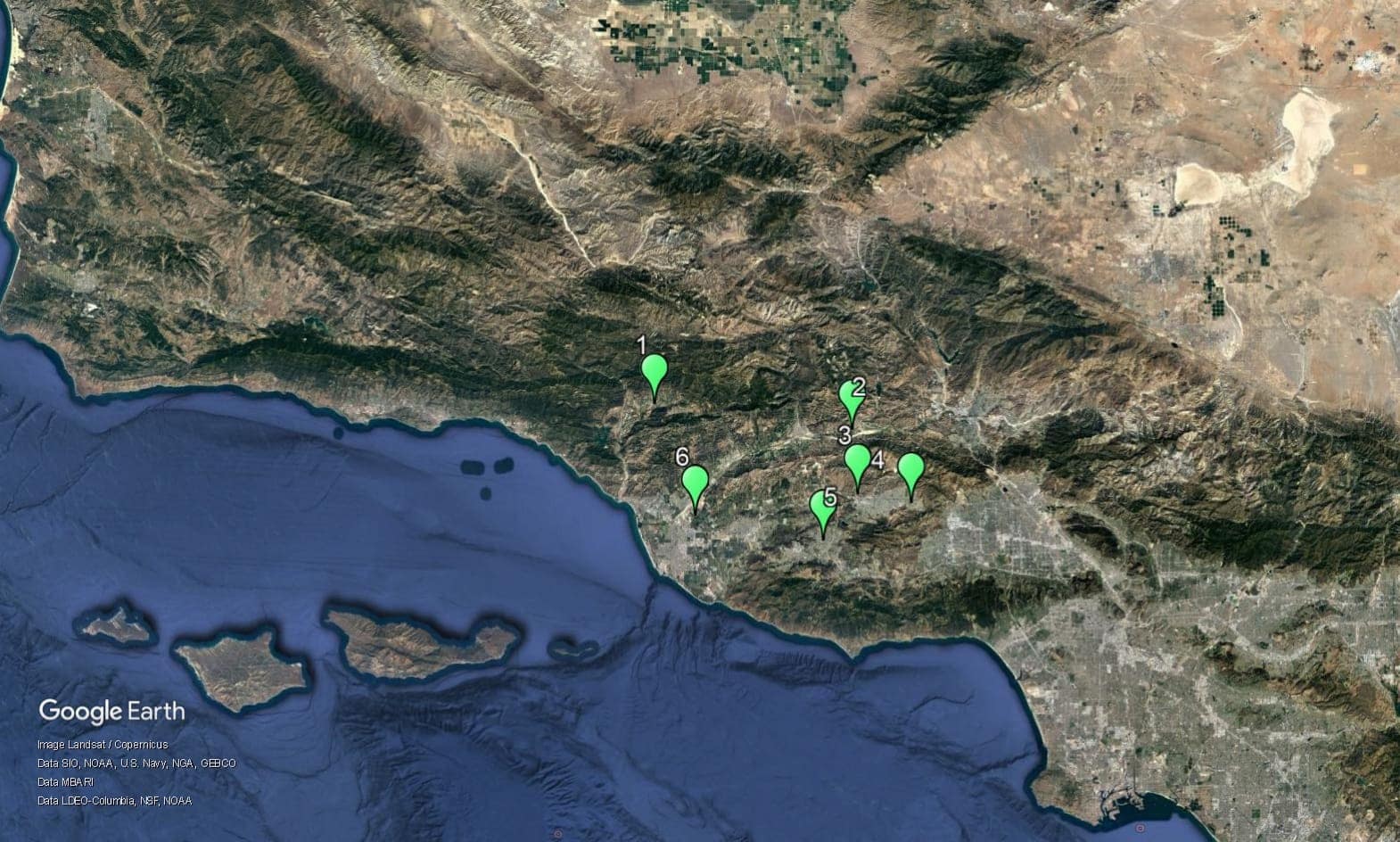
1- Ojai | 2- Piru | 3- Simi Valley-Upper Air | 4- Simi Valley-Cochran St. | 5- Thousand Oaks | 6- El Rio
If you have any questions, call or email Wunna Aung at 805-303-3659.