

Introduction
VCAPCD regulates asbestos renovation and demolition projects through Rule 62.7. It requires that the district be notified prior to the start of work in some instances. Notification requirements are detailed below. In all instances, people need to exercise caution when it comes to exposure to possible asbestos-containing material when it is disturbed.
Health Risks
The Environmental Protection Agency (EPA) has determined that there is no completely safe level of exposure to asbestos. Exposure to asbestos occurs when its fibers are released into the air and inhaled. While they are not visible, these fibers can be deadly.
The danger occurs when smaller fibers in the air become embedded in the lungs, and the body has no way to remove them. Usually, symptoms do not appear for many years after the first exposure.
Exposure to asbestos increases the risk of lung cancer and mesothelioma, a form of cancer that most often affects the thin linings surrounding the organs in the chest and abdomen, according to the American Cancer Society. Cancer of the stomach and internal organs such as the mouth, esophagus, larynx, kidneys and colon also have been linked to asbestos exposure.
Each exposure to asbestos increases an individual's risk of acquiring asbestos-related diseases.
Where Asbestos is Found
Asbestos is likely to be found in buildings constructed before 1979 and almost certain to be present in those built before 1950. Asbestos was often sprayed or troweled on ceilings and walls for thermal, acoustical and decorative purposes. It may also be found in insulation for stoves, furnaces, boilers, pipes, walls and ceilings. Vinyl floor tiles, sheet flooring, patching compounds, cement shingles, artificial fireplace logs and textured paints are other areas where asbestos was commonly used. Frequently, asbestos fibers are mixed with materials that bind them together producing asbestos-containing material (ACM).
Exposure to asbestos can occur in home improvement and construction projects. For example, cutting a ceiling section may disturb sprayed-on decorative ACM. Replacing plumbing pipes may expose you to deteriorating asbestos coverings. Cutting through shingle siding may expose you to insulation fibers.
In most cases, ACM is only dangerous when it is disturbed.
Determining if Asbestos is Present
Unless it is clearly labeled, it is impossible to visually detect asbestos. If you suspect a material contains asbestos, you can hire a California state-licensed asbestos consultant to conduct a survey and take samples of the materials to a laboratory for analysis or you can take samples yourself.
If you choose to sample suspect material yourself, first wet it by using a spray bottle filled with water. After the material is thoroughly penetrated by water, carefully remove it and place it in a clean, leak-tight container. Take the sample to an asbestos laboratory for analysis.
To find a licensed consultant or laboratory in your area, search for those that mention "Asbestos" or "Environmental" in their list of services.
Bulk sample analysis determines the quantity (percent by area estimate), as well as the specific type of asbestos for each sampled area.
Results from analyses are interpreted as follows:
- If one or more samples from the suspect ACM contains greater than 1% asbestos, the entire material is considered to contain asbestos.
- If a doubt exists or further information is needed, samples should be reanalyzed or subjected to point counting.
If Asbestos is Present
If the material is identified as ACM and it is in good condition, the VCAPCD recommends leaving it alone. If the ACM is damaged, or if renovation, repair or remodeling may disturb the material, you should hire a California state licensed asbestos abatement contractor to remove it in a safe and legal manner.
For an asbestos removal contractor list, visit the Contractors State License Board website, contact the VCAPCD or search the internet for "Asbestos Abatement and Removal Service."
Removal of ACM
If a building or home is being demolished, a licensed asbestos contractor must first remove all ACM. If a building or home is being renovated and the ACM may be disturbed, it must first be removed by a licensed asbestos contractor.
Owners/occupants of single-unit dwellings personally performing renovations or demolitions are not regulated by Rule 62.7. However, the VCAPCD strongly recommends that such operations be conducted in conformance with the rule's emission control requirements.
The disposal of waste ACM must be in accordance with federal hazardous waste and state toxic waste laws.
Surveying for ACM
Your building or home must be surveyed in order to obtain a demolition permit. A licensed asbestos contractor must remove the asbestos before demolition starts. An asbestos survey must be completed if ACM will be disturbed during remodeling and repair work.
Asbestos regulations
The EPA established the National Emission Standards for Hazardous Air Pollutants (NESHAP) for Asbestos to minimize the release of fibers during activities involving asbestos handling. The district regulates asbestos demolition and renovation operations using Rule 62.7 instead of the NESHAP.
Rule 62.7 applies to all renovation and demolition operations, including those not previously regulated under NESHAP. The rule applies to operations at dwelling units and operations involving 100 or more square feet of ACM. Residential single-unit dwellings where the owner/occupant performs such operations are exempt.
Notification Requirements
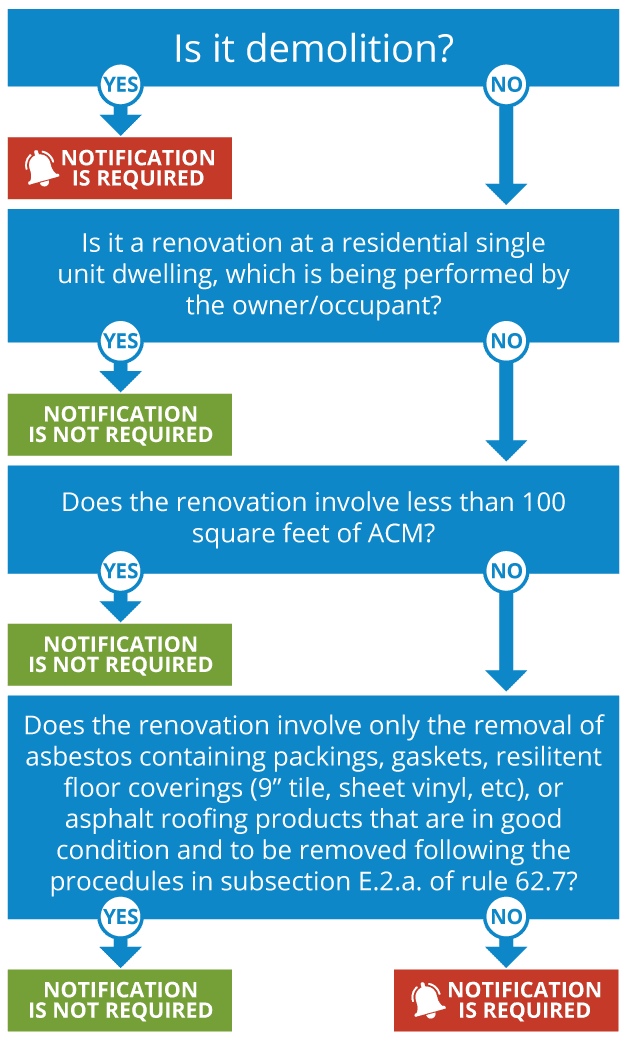
The demolition flow chart to the right indicates the provisions of Rule 62.7 and explains when a written notification must be submitted to the VCAPCD.
If 100 or more square feet of ACM will be removed, a written notification must be submitted to the VCAPCD. Written notifications must be postmarked or delivered to the district at least 10 working days prior to starting the work and must be accompanied by the fee specified in VCAPCD Rule 45.2. The VCAPCD Notification of Demolition or Renovation ENF-62 form should be used by demolition contractors and asbestos abatement contractors.
If the operation is at a residential building having four or fewer dwelling units, the 10-day waiting period and fee do not apply, but the district must receive the notification prior to beginning demolition or renovation work.
Homeowners personally performing asbestos removal operations in their primary residence are exempt. However, the VCAPCD strongly recommends that licensed, trained professionals perform such operations.
The VCAPCD Asbestos Notification Revision ENF-62R form can be used to submit revisions to information on the VCAPCD Notification of Demolition or Renovation form.
Fees
If an asbestos renovation or demolition operation requires a written notification, district Rule 45.2 specifies the fees to be submitted with the notification.
No fee is required for projects at a residential building having four or fewer dwelling units.
Fees are divided into the following categories:
- Each project involving the removal of 100 square feet or more but less than 1,000 square feet of asbestos-containing material (ACM) shall be assessed a fee of $289.38.
- Each project involving the removal of 1,000 square feet or more but less than 5,000 square feet of ACM shall be assessed a fee of $690.06.
- Each project involving the removal of 5,000 square feet or more of ACM shall be assessed a fee of $1,085.17.
- Any revisions to removal or demolition dates, amounts of asbestos present or removed, or contractors, transporters or disposal site shall be assessed a fee of $66.78.
- Each demolition project not involving ACM shall be assessed a processing fee of $189.20.
Fees are due prior to the start of asbestos removal.
Abatement Equipment
The district does not require a Permit to Operate for HEPA filter vacuums or HEPA filter negative air machines associated with asbestos abatement or removal.
Asbestos Consultants
For a list of asbestos consultants and certified site technicians please see the California Department of Occupational Safety and Health (DOSH) California Asbestos Consultants and Certified Site Technicians database or search the internet for Asbestos Consulting and Testing.
The district does not recommend or endorse any consultant.
The Business and Professions Code and the Labor Code require asbestos consultants and site surveillance technicians to be certified by the DOSH.
Asbestos Contractors
For a list of asbestos contractors, please consult the California Asbestos Registrants' Database.
The district does not recommend or endorse any contractors.
Rule 62.7 does not apply to operations at residential single-unit dwellings where the owner/occupant performs such operations. However, the district strongly recommends that such operations be conducted in conformance with the emission control requirements of this rule. The waste disposal of asbestos-containing materials must be in accordance with state and federal hazardous waste laws.
Homeowners who perform their own removal work can contract with the registered asbestos contractors for transportation, disposal or bagging of asbestos-containing waste. Contact the contractor to determine which services are offered. For additional listings, search the internet for "Asbestos Abatement and Removal Services."
Tips for Hiring a Contractor
- Check the Contractors State License Board database to make sure the contractor you are considering has a valid current license and certificate for asbestos abatement work. You can also call 800-321-2752.
- Call the Van Nuys Cal/OSHA district office at 818-901-5403 to make sure the contractor has current registration as an asbestos abatement contractor.
- Make sure the contractor has general liability insurance as well as asbestos-specific coverage. If not, the homeowner or property owner may be liable for any worker injury.
- Get bids from at least three different qualified and licensed contractors. Ask each for references.
- Clearly define the parameters of the project and your expectations for each bidding contractor. Beware of any bid that is substantially lower than the others. This may mean the contractor takes short cuts at the expense of safety.
Source: Contractors State License Board
Asbestos disposal sites
Disposal of asbestos-containing material (ACM) from renovation at a residential single-unit dwelling performed by the owner/occupant must be disposed of in accordance with state and federal regulations.
The following disposal site located near Ventura County accepts all types of ACM. Call the landfill prior to transporting asbestos material to it:
- Azusa Land Reclamation Management Facility
626-334-0719, 1211 W. Gladstone St., Azusa, CA 91702
The following disposal sites in Ventura County accept only non-friable (Category I* & II**) types of ACM. Call the landfill prior to transporting asbestos material to it.
- Toland Road Landfill
805-525-8217, 3500 N. Toland Road, Santa Paula, CA 93060
(waste originating in the Santa Clara Valley only) - Simi Valley Landfill
805-579-7267, 2801 Madera Road, Simi Valley, CA 93065
*Category I non-friable ACM is asbestos-containing packings, gaskets, resilient floor covering and asphalt roofing products that are not in poor condition and contain more than 1% asbestos.
**Category II non-friable ACM is any material, excluding Category I non-friable ACM, containing more than 1% asbestos that, when dry, cannot be crumbled, pulverized or reduced to powder by hand pressure. Transite pipes and transite/cement shingles are examples.
Note: The Del Norte Regional Recycling & Transfer Station does not accept any ACM.
Laboratories
- LA Testing
800-303-0047, 520 Mission St., South Pasadena, CA 91030 - Forensic Analytical Consulting Services
310-906-4844, 4900 Airport Plaza Drive, Suite 115, Long Beach, CA 90815
Note: The district does not recommend or endorse any laboratories.
More Information
For additional information about asbestos, Rule 62.7 or notification fees, email asbestos@vcapcd.org or call Ken Hall at 805-303-3709 or Kourtney Heald at 805-303-3702.
Asbestos webpages: